Largest Contentful Paint (LCP)
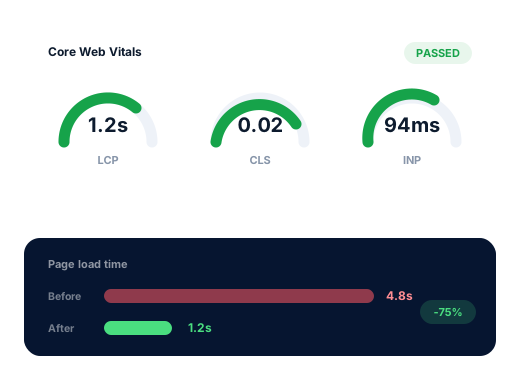
LoadingMeasures when the largest item on screen, often the hero picture or main heading, is fully shown. Google wants 2.5 seconds or better. Heavy photos and a sluggish host cause most failures.

Speed Optimization
Faster pages for Niagara Falls business websites, tested the way customers really load them: on a phone, on mobile data, often in a car queue, a parking lot or a hotel lobby.

On your office connection your site may feel quick. Your customers rarely meet it that way. A visitor opens it in a line of cars at the border, on a weekend GO train out of Toronto, or on the sidewalk after the fireworks, deciding where to eat. A resident opens it in a waiting room or a parked car. These are first visits, on mobile data, with nothing stored in the browser, and the same page can take several times as long to appear.
People who wait too long tap back and choose the next result, and Google’s ranking systems take account of speed figures collected from real Chrome users. A lighter page helps on both counts.
The pressure is greater in a city where so many searches are tied to the moment: “restaurants niagara falls ontario open now”, “clifton hill restaurants open now”, “niagara falls walk in clinic wait times”. Someone comparing three places on a small screen will not sit through a heavy slideshow. The page that shows its hours, menu or booking button first has the edge.
Search demand
Verbatim Google.ca suggestions from October 2026. None is about speed itself; every one is made by someone on a phone who wants an answer now.
Not every page needs the same effort. The visits that count are usually the hurried ones: a menu opened on the sidewalk, hours checked before a drive across the city, a ticket or booking page opened in a hotel lobby. Our analytics review picks out those pages and they go to the front of the queue. The goal is a pass in Google’s real-visitor data; squeezing out the final lab points seldom earns an extra booking.
Usual causes
Usually more than one is at work.
One image from a modern phone can weigh several megabytes, then appear in a box a few hundred pixels wide. Resizing it to the space and saving it as WebP removes most of the weight. Sites built around big scenic galleries suffer most.
Common with restaurants, tours and venues. A phone must download the whole file before anything can be read, and text locked in a file or image does little for search. A plain web page loads faster and can be found.
A third-party booking or ticket tool can add a heavy bundle of code to every page, including ones with no booking button. Loading it only where it is used makes a large difference.
Pop-up offers, live chat, a social feed, a weather widget, two or three tracking tags and an embedded map: each makes extra requests, and few get reviewed after installation.
When the server needs a full second just to start replying, no amount of front-end work recovers it. Caching softens the problem; sometimes moving host is the honest answer.
What Google measures
Google collects these from real Chrome visits over a rolling 28 days. A page passes once at least 75% of visits meet the target on all three.
Measures when the largest item on screen, often the hero picture or main heading, is fully shown. Google wants 2.5 seconds or better. Heavy photos and a sluggish host cause most failures.
Measures the pause after a tap before anything changes on screen. Google wants 200 milliseconds or better. Chat bubbles, carousels and stacks of tracking code are frequent offenders.
Measures how much content jumps as late items arrive, the reason someone aims for “Call” and hits “Directions”. A score under 0.1 passes; reserving room for photos and banners usually gets you there.
The work
We record lab and real-visitor numbers for the pages that matter before touching anything, so the gain can be demonstrated.
Each photo cut to the size it is displayed at, compressed, converted to WebP for browsers that read it, and held back until the visitor scrolls close.
PDF and image-only menus, room rates and tour times rebuilt as light HTML, quicker to load and readable by search engines.
Unused plugins removed; booking tools, chat and tracking loaded after the main content; fonts served from your own site.
Caching rules matched to your hosting setup, so a second visit is quicker still.
Lab checks rerun the day changes go live; real-visitor data checked again after Google’s next 28-day window fills.
Done carefully
Standards we keep for every client, set out here so you can check us against them.
Speed cannot make up for thin pages, and nobody needs a flawless score to rank in this city.
Page speed is just one of many ranking signals; its surest payoff is fewer visitors abandoning the page. When yours is quick enough, we will tell you and suggest better uses for the money, such as new service pages or Business Profile work. Speed work is quoted once, after an audit.
Ask us about your business
How we work
Four stages that move a Niagara Falls business from overlooked to shortlisted.
We read through your website and Business Profile and test your rankings from spots across town, Chippawa to Stamford.
We shortlist the searches that lead to paying customers and pair every one with a page built for it.
Fixes to the profile, site, content and listings, beginning where the gain is largest.
Each month, a short plain-language note on calls, messages and positions, and the next priorities.
Questions
Your office has fast wifi, a recent computer and a browser that has already stored most of the page. Google’s field data comes from real visitors, most of them on phones and many arriving for the first time. Open the site on your own phone with wifi switched off and you will see what they see.
Google’s bar: the main content up within 2.5 seconds on a phone, taps answered inside 200 milliseconds, and a layout that stays put while loading.
Rarely. The same photo can usually be shown at a fraction of its file size, sized to the screen it appears on and loaded only when the visitor scrolls to it. Most galleries keep every picture and lose most of the weight.
Usually. On a phone a PDF opens slowly, needs pinching and zooming, and its contents help your search visibility very little. Rebuilding it as an ordinary page tends to solve all of that.
Most small sites need one to two weeks of work. Google’s real-visitor data looks back 28 days, so the pass appears roughly four weeks after launch.
An audit comes first, then a single quote in CAD, because each slow site has its own mix of causes. Afterwards, holding on to the gains is covered by the routine care built into our plans at $300, $500 or $700 per month.
Further reading
More on this subject for business owners in Niagara Falls and the region.
Any of these can be hired on its own; plenty of clients begin with one.
People look for each of these trades in their own way, so every page rests on its own research.
We will check, at no charge, your rankings between Chippawa and St. Catharines, name the businesses above you, and put the fixes in order.
Request my free audit